
What Is the 20% Rule for Solar Panels? A Chinese Supplier’s Practical Guide
Learn the 20% rule for solar panels—definition, importance, and application—from a Chinese supplier’s perspective. Discover how to balance efficiency, cost, and reliability with tailored solutions.
tonybuy
12/29/20253 min read
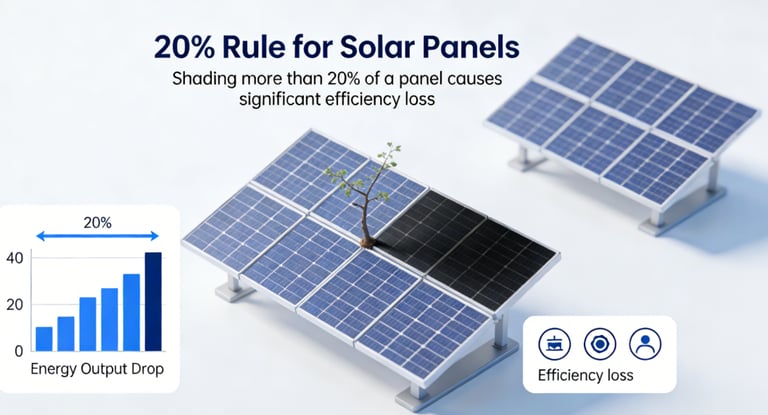
As a leading Chinese solar panel supplier, we often receive inquiries from global clients about the "20% rule"—a widely discussed guideline in solar system design. Whether you’re a homeowner planning a residential installation or a project developer scaling up commercial solar farms, understanding this rule is critical to optimizing your system’s performance and return on investment. In this guide, we’ll break down what the 20% rule entails, why it matters, and how Chinese suppliers integrate it into tailored solutions for global markets.
First, let’s clarify the core definition: The 20% rule is a practical design principle that recommends sizing your solar system to generate 20% more energy than your average monthly or annual electricity consumption. For example, if your home uses 1,000 kWh of electricity per month, the rule suggests installing a system capable of producing 1,200 kWh monthly. This extra 20% acts as a buffer to offset real-world energy losses and unforeseen demand spikes—a key consideration we emphasize to clients to avoid underperformance.
Why is this buffer so essential? From our experience supplying panels to over 50 countries, real-world conditions rarely match ideal laboratory settings. Solar rack systems face inevitable energy losses: inverters typically lose 2-5% of energy during DC-to-AC conversion, wiring and connectors account for another 2-3%, and dust, shading, or extreme weather can reduce panel efficiency by up to 10% . Additionally, panel aging causes a 0.5-1% efficiency drop annually. The 20% buffer ensures these losses don’t leave you short of power. It also covers seasonal demand surges, such as increased air conditioner use in summer or heating needs in winter—common scenarios across both tropical and temperate markets we serve.
For Chinese suppliers, the 20% rule isn’t just a theoretical guideline—it’s a foundation for customized system design. We leverage our manufacturing expertise and global market insights to help clients apply this rule effectively. For instance, clients in high-latitude regions with shorter daylight hours (like Northern Europe) need a more robust buffer, so we may adjust the rule to 25-30% and recommend high-efficiency monocrystalline panels (with 25.8%+ efficiency ) to maximize energy generation. In contrast, clients in sun-drenched regions like the Middle East may stick to the standard 20% or even adjust it slightly lower, paired with our lightweight, anti-corrosion panels tailored for desert environments.
Another key point we highlight to global clients is the difference between the 20% design rule and the NEC 120% safety code—an important distinction that avoids confusion. The latter is a U.S. electrical safety regulation limiting combined utility and solar power to 120% of the electrical panel’s busbar rating , while the 20% rule focuses on energy generation vs. consumption. As a supplier familiar with international codes, we ensure our panels and system recommendations comply with both design guidelines and local safety standards, whether it’s NEC for the U.S. or CE for the EU.
Cost optimization is another area where the 20% rule adds value—something we prioritize as Chinese suppliers committed to cost-effectiveness. Oversizing a system beyond the 20% buffer wastes money on unnecessary panels and installation, while undersizing leads to insufficient power and lost savings. Our team works with clients to analyze their energy bills, assess local weather conditions, and use tools like NREL PVWatts to calculate the exact system size needed. This data-driven approach, combined with our scalable manufacturing capacity, allows us to offer tailored solutions that balance performance and cost—from residential kits to large-scale commercial projects.
We also help clients adapt the 20% rule to future needs. With the growing adoption of electric vehicles (EVs) and home storage systems, energy demand may increase over time. The 20% buffer provides flexibility for future expansions, such as adding more panels or integrating storage. For example, we recently worked with a European client to design a system with a 20% buffer that could easily accommodate an EV charger upgrade—a solution that enhanced the system’s long-term value.
It’s worth noting that the 20% rule isn’t one-size-fits-all. Factors like net metering policies, storage availability, and microclimates can influence adjustments. In regions with favorable net metering (where excess energy is sold back to the grid), clients may opt for a slightly larger buffer to maximize revenue. In areas with storage subsidies, we may recommend allocating part of the 20% buffer to battery storage instead of extra panels , a strategy that improves ROI and energy independence.
As Chinese solar suppliers, our role goes beyond providing high-quality panels—we act as partners in optimizing your solar investment. The 20% rule is a simple yet powerful tool to achieve this, ensuring your system is efficient, reliable, and cost-effective. By combining this guideline with our technical expertise, global market knowledge, and tailored manufacturing capabilities, we help clients across the world get the most out of their solar installations.
In summary, the 20% rule is about practicality: it bridges the gap between ideal and real-world solar performance, balances cost and efficiency, and adapts to diverse market needs. Whether you’re a first-time buyer or an experienced developer, working with a Chinese supplier who understands how to apply this rule to your specific situation can make all the difference. Reach out to our team today to discuss how we can tailor a solar solution that aligns with the 20% rule and your unique goals.
Unit 10, Smithfield Road Industrial Hengshui
Hebei Province
Beijing
China
+86 18633908188
tony.buy@gmail.com