
Snow Load Considerations for Solar Mounting Structures: Structural Design, Drift Effects & Code Compliance Guide
Snow load governs solar mounting structural design in a larger share of global deployments than most EPC engineers account for at the early design stage. In Canada, Norway, Sweden, Finland, northern Japan, and the northern tier of the United States — regions representing collectively over 180 GW of installed solar capacity — ground snow loads of 2.0–4.0 kPa are standard, producing design roof snow loads on solar panel arrays that exceed structural dead load by 3–6× and exceed wind uplift net demand in all but the highest-wind-speed coastal classifications. The critical structural difference between snow and wind is duration: a design wind event lasts seconds to minutes; a design snow accumulation may persist for weeks or months, sustained through multiple freeze-thaw cycles that progressively increase density and introduce ice-lens formation that concentrates load. This snow load engineering guide is part of our comprehensive Solar Mounting Materials & Structural Engineering Guide — covering the complete design chain from climate load determination through section specification, structural calculation, connection design, and foundation selection for solar mounting structures across all global deployment environments.
Snow accumulation can govern solar mounting structural capacity in cold climates more than wind or seismic loads — and the structural consequences of snow load underspecification are disproportionately severe because the loading builds gradually and invisibly, frequently reaching maximum intensity at mid-winter when accessibility for emergency inspection and remediation is most constrained.
Technical Snapshot: Snow Design Parameters for Solar Mounting Structures
| Parameter | Typical Value Range | Governing Standard | Engineering Note |
|---|---|---|---|
| Ground Snow Load (pg / Ss) | 0.5–4.0 kPa (10–83 psf) in cold-climate solar markets | ASCE 7-22 Fig. 7.2-1 (RC II); NBCC 2020 Table C-2; EN 1991-1-3 | ASCE 7-22 replaced single pg map with four Risk Category-specific maps; values increased 10–35% in many U.S. regions vs ASCE 7-16 |
| Flat Roof / Array Snow Load (pf) | 0.35–2.8 kPa for ground-mount fixed-tilt at Ce = 1.0, Ct = 1.0 | ASCE 7-22 Eq. 7.3-1: pf = 0.7 × Ce × Ct × pg | Importance factor removed from pf equation in ASCE 7-22; now embedded in RC-specific pg maps |
| Snow Drift Multiplier | 1.5–2.5× uniform load at leeward obstruction face | ASCE 7-22 Section 7.7–7.9; EN 1991-1-3 Annex B | Inter-row drift from upwind panel row is the dominant drift case for ground-mount arrays; often omitted from design |
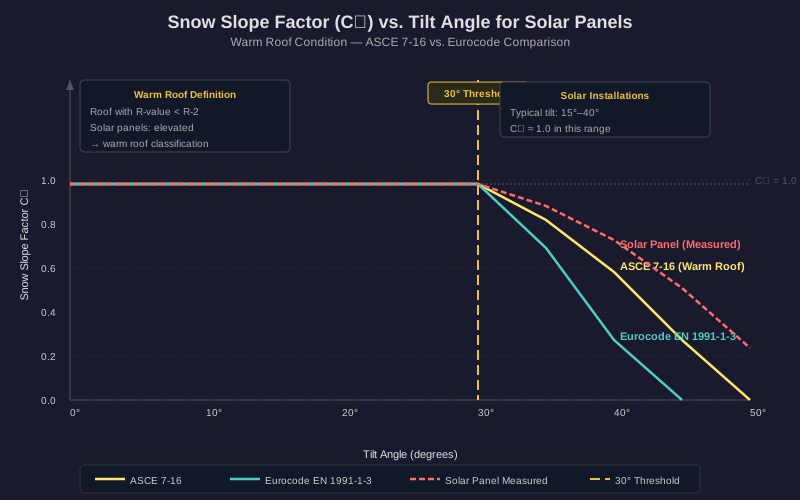
| Slope Reduction Factor (Cs) | Cs = 1.0 at 0–5° tilt; reduces linearly above 30° for warm roofs | ASCE 7-22 Section 7.4; NBCC 2020 Art. 4.1.6.16 | Glass-faced PV panels classified as “slippery surface” (Cs reduction available above 15° for warm conditions); obstructed sliding zones per NBCC 2020 require Cs = 1.0 upslope of panel array |
| Governing Standard | ASCE 7-22 (U.S.) · NBCC 2020 (Canada) · EN 1991-1-3 (EU) | Varies by jurisdiction | All three standards revised solar-specific provisions between 2020 and 2022; prior-edition calculations may be non-conservative |
Engineering Context
Why Snow Load Often Governs in Northern Regions
In cold-climate solar markets, three structural characteristics combine to make snow the governing load case for rail and column design: magnitude, duration, and non-uniform distribution. Magnitude: a ground snow load of 2.8 kPa (the mapped value for much of Manitoba, Ontario, and Quebec in Canada) converts to a flat roof snow load of 1.96 kPa on the panel array — producing a rail gravity load of 3.43 kN/m on a 1.75 m tributary width, which is 2.5–4× the panel dead load contribution and significantly exceeds wind uplift net demand at equivalent ASCE 7 Exposure C sites below 130 mph. Duration: snow load persists through the entire winter season — typically 3–5 months in Canadian Prairie and Scandinavian deployments — applying a sustained compression on rail members that creates long-term deflection from viscoelastic creep in aluminum extrusion sections and progressive joint settlement at column base connections. Non-uniform distribution: ground-mounted arrays at standard inter-row spacing (3–6 m) create drift formation zones on the leeward face of the upwind panel row, increasing local snow load by 50–150% above the uniform design value. The geographic and climate data framework for identifying which regional standard governs and what ground snow load value applies at each project location is provided in the regional climate design guide, which consolidates snow, wind, seismic, and atmospheric corrosivity inputs for the major cold-climate solar deployment regions.
Structural Behavioral Differences Between Snow and Wind Load
Wind and snow loads engage solar mounting structures through fundamentally different mechanical mechanisms, requiring different structural responses. Wind is a dynamic uplift load: acting perpendicular to the panel surface, peaking instantaneously in gust events, and creating net tension (uplift) at pile foundations that is offset only by structural dead load — the governing pile limit state is tension extraction, not bearing. Snow is a sustained gravity compression load: acting vertically downward on the panel-and-structure system, accumulating gradually over days to weeks, and placing rail members in bending and columns in axial compression — the governing pile limit state shifts from tension to bearing pressure, and the governing rail limit state shifts from uplift bending to deflection under gravity. These behavioral differences mean that a project designed for wind without explicit snow verification may have correctly specified piles (adequate compression bearing capacity) but underspecified rail sections (inadequate bending stiffness under gravity). The complete wind load calculation methodology and the governing ASCE 7-22 uplift demand for direct comparison with snow bending demand are documented in the wind load calculation resource.
Engineering Fundamentals
Ground Snow Load (pg): Mapped Design Value and Standard Methodology
Ground snow load (pg in ASCE 7; Ss in Eurocode; Ss in NBCC 2020) is the mapped 50-year mean recurrence interval (MRI) snow load at grade level, derived from statistical analysis of historical snowpack records at climate stations. Under ASCE 7-22, pg is extracted from four separate Risk Category-specific ground snow load maps (Figures 7.2-1A through 7.2-1D) — a major revision from ASCE 7-16, which used a single map with a separate importance factor multiplier. The four-map approach reflects the statistical finding that the ratio of RC III/IV snow load to RC II snow load is not constant across the U.S. — it is climate-dependent — making risk-category scaling via a single importance factor systematically inaccurate. In practice, ASCE 7-22 pg values for RC II structures increased 10–35% in many northern U.S. regions relative to the ASCE 7-16 factored values, with particularly large increases in the Great Lakes region, upper Midwest, and Pacific Northwest mountains. For solar mounting structures — classified as Risk Category II per ASCE 7-22 Section 1.5.1 — the RC II pg map (Figure 7.2-1B) is the governing input.
Roof / Array Snow Load Conversion Formula
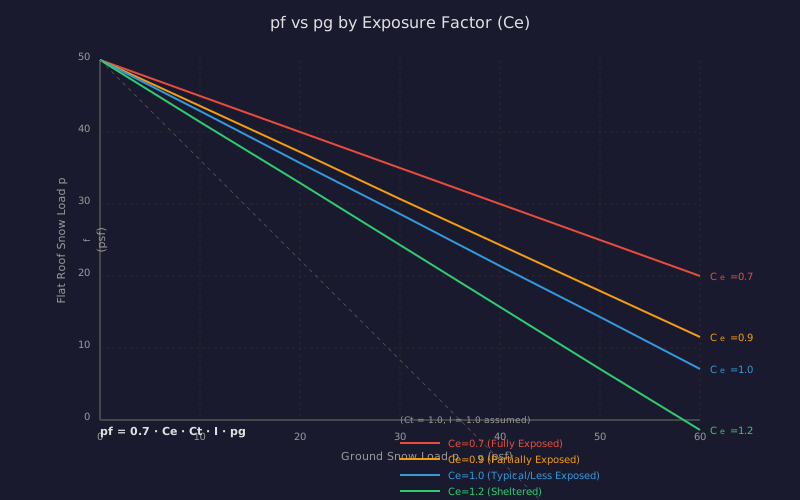
Ground snow load converts to the flat roof (array surface) design snow load through the ASCE 7-22 flat roof equation:
\[ p_f = 0.7 \times C_e \times C_t \times p_g \]
where: Ce = exposure factor — accounts for wind scouring of snow from the array surface; Ce = 0.8 for fully exposed ground-mount arrays in open terrain (Exposure C, all winds); Ce = 1.0 for partially exposed arrays surrounded by obstructions or terrain features; Ce = 1.2 for sheltered arrays in forested or urban settings where surrounding obstructions prevent wind scouring. Ct = thermal factor — accounts for heat loss through the roof/panel surface that contributes to snow melting; for solar panels, Ct = 1.0 (unheated structure; panel surface temperature is approximately equal to ambient during winter non-operating periods) per ASCE 7-22 Table 7.3-2. For the flat roof case: pf,min = 20 psf (0.96 kPa) at pg ≥ 20 psf locations, per ASCE 7-22 Section 7.3.4 — a minimum floor that prevents underspecification at low-snow-load sites. For sloped panel surfaces, the roof slope reduction factor Cs reduces the flat roof value: Cs = 1.0 for tilt ≤ 30° on glass-faced “slippery” panels (the condition applicable to most crystalline silicon PV modules); Cs reduces linearly from 1.0 to 0.0 between 30° and 70° tilt for warm roof conditions per ASCE 7-22 Figure 7.4-1b. Therefore: sloped surface design snow load = pf × Cs. Under NBCC 2020, Canada’s equivalent equation is: S = Is × [Ss(CbCwCsCa) + Sr], where the accumulation factor Ca specifically addresses solar panel geometry per the 2020 NBCC Article 4.1.6.16 introduced to address solar arrays.
Snow Drift Effects on Ground-Mount Solar Arrays
Snow drift occurs when wind-transported snow accumulates on the leeward side of an obstruction — and ground-mounted solar panel rows act precisely as obstructions when wind blows along the array row direction or at oblique angles to the row. The dominant drift case for ground-mount arrays is inter-row drift: the upwind panel row acts as a windward obstruction; snow transported over the panel surface deposits in a wedge-shaped drift on the leeward face of the panel and the ground surface between rows, with the maximum drift depth (hd) reached at the base of the upwind panel’s leeward edge. Under ASCE 7-22 Section 7.7–7.9, the drift surcharge load is calculated from the drift geometry (length ld, height hd) derived from pg and the obstruction geometry. For inter-row spacing below 3.0 m, the drift from the upwind panel row may reach the base of the downwind panel row, creating a combined drift-plus-uniform load case where local rail load reaches 1.8–2.5× the uniform design value — a condition that governs rail design in high-snow, close-row-spacing configurations that are common in land-constrained northern deployments. EN 1991-1-3 Annex B provides the equivalent drift geometry calculation methodology for EU projects.
Load Path Under Snow: Rails, Columns, and Foundations
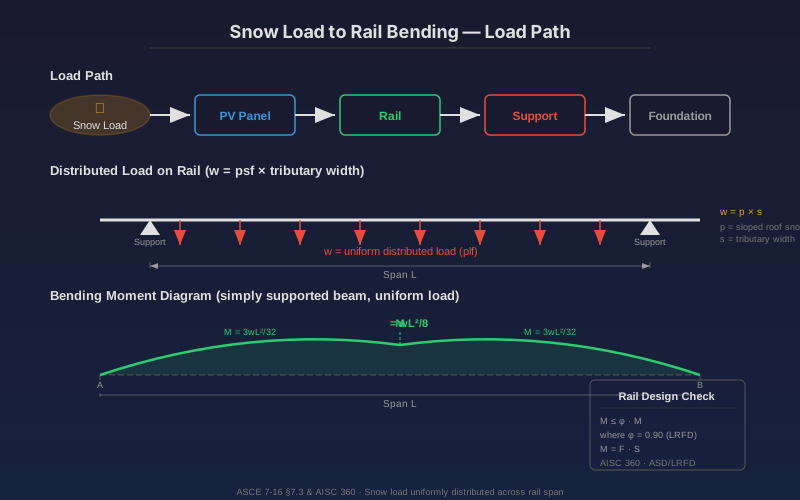
Snow load transmits through the solar mounting structure as a gravity compression chain: panel weight plus snow weight → module clamp → rail bending → column axial compression → pile head bearing → soil bearing capacity. The critical structural difference from the wind uplift chain is that the governing limit state at the rail level is mid-span deflection under sustained gravity load (L/180 or L/240 serviceability limit), not uplift connection capacity. The rail section dimensions that determine stiffness under snow gravity loading — including the interaction between wall thickness, span, and deflection compliance — are quantified in the material thickness and strength resource.

Design Standards & Cross-Reference
Three primary standards govern snow load specification for solar mounting structures across the major cold-climate deployment markets. ASCE 7-22 (Minimum Design Loads and Associated Criteria for Buildings and Other Structures, Chapter 7) is the governing U.S. standard — adopted by IBC 2024 and required for permit submissions in all U.S. jurisdictions; the 2022 edition replaced the single ground snow load map with four Risk Category-specific maps, eliminated the importance factor from the pf equation, and revised the thermal factor Ct table. NBCC 2020 (National Building Code of Canada, Part 4, Article 4.1.6.16) introduced dedicated solar panel snow load provisions for the first time in Canadian code history — requiring the more critical of two load cases (with solar panels versus without solar panels) to govern design, and defining the accumulation factor Ca specific to solar panel geometry. EN 1991-1-3:2003+A1:2015 (Eurocode 1: Actions on Structures — Snow Loads) governs in EU member states — using characteristic ground snow load sk from National Annex maps and the design equation: sd = μi × Ce × Ct × sk, where μi = roof shape coefficient equivalent to Cs in ASCE 7.
Risk Category and Snow Load Importance by Standard
| Standard | Risk Category / Consequence Class | Solar Mounting Classification | Snow Load Importance Treatment | Design Snow Load Relative to RC II |
|---|---|---|---|---|
| ASCE 7-22 | Risk Category I (low occupancy) | Not applicable to standard solar mounting | Separate pg map (Fig. 7.2-1A); lower design values | −10 to −20% of RC II value (site-dependent) |
| ASCE 7-22 | Risk Category II (standard occupancy) | Ground-mount solar mounting per Section 1.5.1 | RC II pg map (Fig. 7.2-1B) — no separate Is factor in pf equation | 1.00× (baseline) |
| ASCE 7-22 | Risk Category III (substantial hazard) | May apply if solar mounting supports essential facility infrastructure | RC III pg map (Fig. 7.2-1C); higher values | +10 to +25% of RC II value (site-dependent) |
| ASCE 7-22 | Risk Category IV (essential facilities) | Critical infrastructure solar; hospital or emergency facility power supply | RC IV pg map (Fig. 7.2-1D); maximum values | +20 to +40% of RC II value (site-dependent) |
| NBCC 2020 | Importance Category Normal (IE = 1.0) | Standard utility-scale solar mounting | Is = 1.0 multiplier on Ss in S equation | 1.00× (baseline) |
| NBCC 2020 | Importance Category High (IE = 1.3) | Solar serving post-disaster or critical infrastructure | Is = 1.15 on Ss component of S | +15% to Ss component only |
| EN 1991-1-3 | Consequence Class CC1 (low) | Small / non-public solar installations | γSd partial factor from National Annex | Country-specific; typically −10 to −15% |
| EN 1991-1-3 | Consequence Class CC2 (medium) | Standard utility-scale solar mounting | γSd = 1.0 (standard) | 1.00× (baseline) |
Engineering Variable Comparison Table
| Design Variable | Sensitivity to Snow Load Demand | Governing Structural Impact | Design Response | Cost Impact |
|---|---|---|---|---|
| Ground Snow Load (pg) | Very High — pf is directly proportional to pg; doubling pg doubles all design snow loads on the array; most location-sensitive input in cold-climate design | Rail bending demand; column axial compression; pile bearing pressure — all scale linearly with pg | Extract pg from site-specific ASCE 7-22 / NBCC 2020 / Eurocode map at exact project coordinates; verify against local AHJ requirements; do not use regional averages | High — upgrading from pg = 1.0 kPa to pg = 2.5 kPa typically requires rail thickness upgrade from 2.0 mm to 2.5–3.0 mm at standard spans, adding $0.005–$0.010/W DC to structural hardware cost |
| Panel Tilt Angle | High — Cs slope reduction begins above 30° tilt for slippery surfaces; steeper tilt promotes snow shedding but increases wind uplift simultaneously; tilt optimization must balance both | Reduced accumulated snow load at tilt ≥ 30° reduces rail bending demand; but same tilt increase amplifies wind pressure coefficient CN in ASCE 7-22 Fig. 29.4-7 | Optimize tilt for combined minimum total structural demand using load combination analysis; never reduce tilt for snow reduction without verifying the resulting wind demand increase; refer to the tilt angle optimization resource for the quantitative tilt-wind-snow interaction framework | Medium — tilt increase above 30° reduces snow load and potentially allows thinner rail; net structural cost depends on whether wind or snow governs after tilt change; requires full structural recalculation |
| Row Spacing | Medium — inter-row spacing below the drift length threshold (ld per ASCE 7-22 Section 7.7) allows drift to reach the downwind panel base, creating a combined uniform-plus-drift load case; row spacing above ld prevents drift reaching downwind panel base | Drift surcharge load on downwind panel rail at close row spacings; drift surcharge at 3.0 m row spacing can reach 1.8× uniform value in high-snow regions | Calculate drift length ld explicitly for the project pg and obstruction geometry; specify drift surcharge load on downwind rows in the structural calculation package; do not assume uniform load governs at close row spacings | Medium — accounting for drift at close-spaced rows may require rail thickness upgrade or span reduction for the leeward rows in each bay; adds $0.003–$0.007/W if not captured in original design |
| Span Length (Post Spacing) | High — mid-span deflection under snow gravity load scales with L⁴; snow load governs deflection at long spans in cold climates; 2.5 m span under pf = 1.5 kPa typically requires 2.5 mm rail; 3.0 m span under same load requires 3.0 mm | Rail mid-span deflection under sustained snow gravity load — the primary serviceability limit state in snow-governed designs; column compression under combined dead plus snow axial load | Verify rail deflection under pf × tributary width at the governing span; confirm L/180 or L/240 compliance; reduce span or increase section thickness if non-compliant; verify column axial interaction ratio under full snow case | High — span increase from 2.5 m to 3.0 m at pf = 1.5 kPa requires rail thickness upgrade from 2.5 mm to 3.0 mm wall; adds approximately $0.006–$0.012/W in rail material cost |
| Exposure Factor (Ce) | Medium — Ce ranges from 0.8 (fully exposed, open terrain) to 1.2 (sheltered by surrounding obstructions); sheltered sites carry 50% more design snow load than fully exposed sites at equal pg | Directly scales all design snow loads; most significant for projects in forested regions, urban settings, or terrain features that prevent wind scouring | Site-specific determination of Ce from ASCE 7-22 Table 7.3-1 based on terrain and surrounding obstruction analysis; default to Ce = 1.0 if site conditions are unclear; Ce = 0.8 requires explicit justification for full exposure | Medium — error from Ce = 0.8 to actual Ce = 1.0 at a sheltered site increases design snow load by 25%; requires structural recalculation and potential section upgrade if discovered post-procurement |
Engineering Calculation Insight: Array Snow Load and Rail Bending Demand
The following worked example demonstrates the complete ASCE 7-22 snow load calculation for a utility-scale ground-mount installation in a high-snow northern climate, from ground snow load input to rail bending moment demand.
Design inputs: Location: London, Ontario, Canada (NBCC 2020 Ss = 1.9 kPa, Sr = 0.2 kPa; ASCE 7-22 pg equivalent ≈ 35 psf = 1.68 kPa); Importance Category Normal (Is = 1.0); Cb = 0.8 (basic roof factor for ground-at-grade per NBCC); Cw = 1.0 (wind exposure factor, partially sheltered row); Cs = 1.0 (25° tilt, tilt < 30°, no slope reduction per NBCC 2020 Art. 4.1.6.16); Ca = 1.0 (tilted panel, non-parallel; per NBCC accumulation factor for ground-mount tilted arrays); post spacing 2.5 m; panel tributary width 1.75 m.
Step 1 — Array surface snow load (NBCC 2020):
\[ S = I_s \times [S_s(C_b \times C_w \times C_s \times C_a) + S_r] = 1.0 \times [1.9 \times (0.8 \times 1.0 \times 1.0 \times 1.0) + 0.2] = 1.72 \ \text{kPa} \]
Step 2 — Design UDL on rail from snow (tributary width 1.75 m):
\[ w_{\text{snow}} = 1.72 \times 1.75 = 3.01 \ \text{kN/m} \]
Step 3 — Combined design UDL (dead + snow) for rail bending check: Dead load wDL = 0.25 kN/m (panels + structure self-weight). NBCC 2020 factored combination: 1.25D + 1.5S = 1.25 × 0.25 + 1.5 × 3.01 = 0.31 + 4.52 = 4.83 kN/m.
Step 4 — Bending moment at mid-span (simply supported, L = 2.5 m):
\[ M = \frac{wL^2}{8} = \frac{4.83 \times 2.5^2}{8} = 3.77 \ \text{kN·m} \]
Step 5 — Required section modulus (S350 steel, fy = 350 MPa, γM0 = 1.0):
\[ Z_{\text{req}} = \frac{M}{f_y} = \frac{3.77 \times 10^6}{350} = 10,771 \ \text{mm}^3 = 10.8 \ \text{cm}^3 \]
A 60×40×2.5 mm RHS provides Zxx = 5.8 cm³ — inadequate: utilization ratio 10.8/5.8 = 1.86 (86% over capacity). An 80×60×3.0 mm RHS provides Zxx = 13.5 cm³ — compliant at utilization ratio 0.80, with 25% margin. This example demonstrates that snow load in a northern climate can require a substantially larger section than would be selected based on wind uplift alone — and that section specification using only dead load or wind load without explicit snow verification produces a structurally deficient design at this pg level. The interaction between section dimension, span, and combined load compliance at long spans is developed in the long span structural design resource.
Real Engineering Case: Snow-Governed Rail Deflection in High-Load Canadian Climate
Project Profile
Location: Moose Jaw, Saskatchewan, Canada (Prairie climate; NBCC 2020 ground snow Ss = 2.8 kPa, Sr = 0.20 kPa; design array snow load S = 2.14 kPa at Cb = 0.8, Cw = 1.0, Cs = 1.0, Ca = 1.0, Is = 1.0) | ISO 12944 Classification: C2 (inland Prairie, low humidity, no coastal influence) | System: 20 MWp fixed-tilt ground-mounted installation at 25° tilt, 2.5 m post spacing — for the structural engineering methodology of utility-scale ground-mounted solar mounting systems in cold-climate high-snow environments | Original Rail Specification: 60×40×2.0 mm cold-formed RHS, S350 grade, HDG to ISO 1461 — specified by the EPC structural engineer using ASCE 7-16 wind-only calculation; NBCC 2020 snow load verification was not performed as a separate limit state check.
Engineering Challenge
At first-winter O&M inspection (February, following a multi-week sustained snowfall accumulation that deposited 32 cm of packed snow on the array surface — approximately equivalent to 1.85 kPa surface load), field measurement confirmed mid-span rail deflection of 22.5–26.8 mm across multiple affected spans. The L/180 serviceability limit for a 2.5 m span = 13.9 mm; the measured deflection exceeded the limit by 62–93%. The design UDL under the measured snow condition — combined with dead load at 1.25D + 1.5S factored combination — was calculated at 4.12 kN/m against which the 60×40×2.0 mm rail at 2.5 m span produced a factored mid-span bending stress of 217 MPa (61.9% above the 134 MPa serviceability-governed equivalent limit). Three spans showed visible permanent set following partial snow removal — indicating that localized yield had occurred at the extreme fiber of the rail section under peak snow accumulation, producing plastic deformation that did not recover on unloading. Connection condition inspection found 6% of module clamp fasteners had backed off from their specified torque values, evidencing the secondary effect of rail rotation under deflection cycling against the clamp engagement geometry.
Structural Adjustment & Outcome
Emergency structural remediation was executed before the second-winter accumulation season: rails replaced with 80×60×2.5 mm cold-formed RHS (S350 grade, HDG ISO 1461), providing Zxx = 11.6 cm³ and Ixx = 55.8 cm⁴ — a 3.9× increase in second moment of area compared to the original 60×40×2.0 mm section (Ixx = 14.4 cm⁴). Intermediate bracing at mid-span was added at every fourth bay using 40×40×3.0 mm angle kicker braces — reducing effective span from 2.5 m to 1.25 m at braced locations, further reducing deflection to below L/400 at braced positions. Post-remediation structural calculation under the 2.8 kPa design snow load confirmed maximum deflection of 6.8 mm at 2.5 m spans (L/368, 2.0× the serviceability limit margin) and 1.7 mm at braced 1.25 m spans (L/735). All module clamp fasteners were re-torqued to specification; no permanent deformation was recorded in the replacement rail sections under the subsequent three winter seasons of monitoring. Total remediation cost: $142,000 — $0.0071/W DC. Original cost of specifying 80×60×2.5 mm from procurement: $0.0055/W DC incremental over the 60×40×2.0 mm baseline — less than 78% of the remediation cost, without the production downtime and warranty risk from the first-winter structural event. The bracing design methodology applied in this remediation — including mid-span kicker geometry and load path redistribution — is detailed in the structural bracing strategies resource.
Failure Risks & Common Engineering Mistakes
Ignoring Snow Drift in Row-to-Row Array Geometry
Snow drift is the single most commonly omitted calculation in solar mounting snow load structural submissions. EPC engineers who correctly calculate the uniform flat roof snow load pf routinely omit the drift surcharge that forms on leeward panel rows from snow transported over upwind rows by prevailing wind. For a project at pg = 2.0 kPa with 3.0 m inter-row spacing, the drift surcharge calculation per ASCE 7-22 Section 7.7 yields: drift height hd = 0.43 × (pg/γ)1/3 = 0.75 m; drift length ld = 4 × hd = 3.0 m; surcharge load at drift peak = γ × hd = 17.3 × 0.75 = 13.0 psf = 0.62 kPa additional to the uniform pf = 0.98 kPa — a combined load of 1.60 kPa, 63% above the uniform-only value. Designing the leeward row rail for 0.98 kPa uniform load when the actual design condition is 1.60 kPa at the drift peak produces a section that operates at 163% of its design capacity under the ASCE 7-22 governing snow case.
Underestimating Importance Factor and Standard Edition Effects
ASCE 7-22 replaced the single ground snow load map of ASCE 7-16 with four Risk Category-specific maps, effectively embedding the former importance factor into the map itself. Projects permitted under ASCE 7-16 with pg = 25 psf and Is = 1.0 may now be subject to pg = 35–40 psf under ASCE 7-22 RC II maps for the same location — a 40–60% design snow load increase with no change in project type or risk classification, driven entirely by the standard update and improved statistical methodology. EPC engineers using ASCE 7-16 for projects that will be inspected or re-permitted under ASCE 7-22 jurisdiction — including any project with a planned 30-year operating life extending well into IBC 2024 / ASCE 7-22 adoption — should verify pg against the current standard at both the project design stage and at any major structural modification.
Designing Only for Uniform Snow Load Without Drift and Unbalanced Cases
ASCE 7-22 Section 7.5 requires evaluation of unbalanced snow load conditions for all roof configurations — including solar panel arrays — where geometry allows asymmetric snow accumulation. For fixed-tilt east-west bifacial arrays, wind-driven drift from the south panel face to the north panel face of the same module creates an unbalanced condition that produces torsional demand on the rail-to-column connection geometry not captured in the symmetric uniform load analysis. For north-south oriented rows, alternating drift deposition between rows under varying wind directions creates demand asymmetry between adjacent bays that governs bracing design at the row ends. The sustained moisture environment created by snow accumulation and freeze-thaw cycling on structural members also dramatically accelerates coating degradation in areas where zinc coating was damaged during installation — particularly at cut edges and installation hole peripheries. Maintaining structural wind and snow capacity through the design life requires coating integrity that begins at installation; the systematic approach to coating specification, inspection threshold definition, and remediation for solar mounting structures in snow-climate C2–C3 environments is documented in the corrosion protection strategies resource.
System Integration Impact
Foundation Bearing Pressure Under Snow Load
Snow load transitions the governing foundation limit state from uplift tension (wind case) to bearing compression (snow case): the full dead plus factored snow load on each pile’s tributary area must be resisted in bearing against the surrounding soil. For a pile tributary area of 2.5 m × 6.0 m (row width × post spacing), at pf = 1.72 kPa and dead load 0.15 kPa: factored compression per pile = (1.25 × 0.15 + 1.5 × 1.72) × 15 = 41.5 kN. This compression demand governs pile tip bearing and base plate specification — and at soft or frost-susceptible soil sites, winter frost heave creates additional upward force on the pile that partially offsets the snow-induced compression while introducing bending at the pile head during heave-and-settlement cycles. The foundation type selection that governs bearing capacity under snow compression loads — and the soil classification inputs required for pile bearing design — are developed in the foundation selection guide.
Seismic and Snow Load Interaction
ASCE 7-22 requires that 20% of the balanced design snow load be included as additional mass in the seismic weight when pg ≥ 30 psf (1.44 kPa) — per Section 12.7.2. This provision reflects the structural reality that sustained winter snow accumulation adds significant mass to the structural system that participates in seismic response; the increased effective weight elevates the seismic base shear demand on foundations and lateral resisting elements simultaneously with the gravity compression from snow. For sites with both high snow load and moderate-to-high seismicity — a condition that applies to the Pacific Northwest, Rocky Mountain, and Alaska markets — the combined snow-plus-seismic load case may govern connection and foundation design above the wind-alone or snow-alone cases. The seismic design framework that governs in SDC C–F sites and quantifies the interaction between snow-induced mass and seismic base shear is documented in the seismic design resource.
Tracker vs Fixed Tilt: Snow Load Structural Implications
Single-axis tracker systems require fundamentally different snow load treatment from fixed-tilt arrays: tracker rows must achieve a stow position (typically 5° from horizontal, or as low as 0°) before design snow accumulation is projected, placing the panel surface nearly horizontal at the worst possible angle for snow accumulation (Cs = 1.0, maximum accumulation). A tracker at 0° horizontal during a 2.8 kPa design snow event carries the same surface snow load as a flat roof — the maximum possible case — without the gravity drainage benefit of tilt. Tracker structural sections must therefore be designed for the stow-position full-accumulation case as the governing snow load condition, even if the normal tracking positions carry substantially less snow due to slope drainage. Torque tube torsional capacity under snow-induced self-weight moment at stow position must also be verified for long tracker rows (> 30 m). The structural specification for tracker systems under combined snow, wind, and operational loads — including stow strategy requirements and torque tube capacity at stow position — is covered in the single-axis tracking systems resource.
Engineering Decision Guide
When Snow Load Governs Structural Design:
- Site pg ≥ 1.0 kPa (ASCE 7-22) or Ss ≥ 1.0 kPa (NBCC 2020) — at this threshold, factored snow load on standard spans begins to exceed wind uplift as the governing rail bending demand in open-terrain Exposure C at wind speeds below 140 mph
- Panel tilt ≤ 30° — Cs = 1.0 with no slope reduction; maximum snow accumulation for the ground snow input
- Inter-row spacing ≤ 4.0 m — drift length ld at pg ≥ 1.5 kPa exceeds 3.0 m; drift surcharge reaches downwind panel base and governs local rail design
- Post spacing ≥ 2.5 m at pg ≥ 1.5 kPa — deflection under snow gravity load governs section thickness selection above wind uplift bending
- Any tracker installation in a snow climate — stow-position horizontal panel is the governing snow accumulation case; must be explicitly verified
When Wind or Seismic Governs Instead:
- Coastal high-wind sites with Vult ≥ 150 mph in Exposure D and pg ≤ 0.5 kPa — wind uplift at array edges dominates all structural limit states
- Tropical and subtropical deployments (latitude below 25°) with negligible snow probability — wind and thermal design governs
- SDC D–F seismic zones with heavy structural mass and low pg — seismic base shear governs lateral load without the ASCE 7-22 Section 12.7.2 snow mass addition (pg < 1.44 kPa)
Cost & Lifecycle Impact
| Snow Design Strategy & pg Environment | Incremental Structural Cost vs Wind-Only Baseline | O&M Requirement | First-Winter Risk Without Snow Verification | 25-Year Structural Risk |
|---|---|---|---|---|
| Wind-only specification in pg ≥ 1.5 kPa zone (60×40×2.0 mm rail, 2.5 m span) | None (underspecified at procurement) | Emergency mid-winter inspection after first snowfall event | Very High — rail deflection exceedance near certain; plastic deformation risk at peak accumulation | Very High — rail replacement required; $0.007–$0.015/W remediation; production downtime; warranty risk |
| Uniform snow specification (pf only, no drift) at pg = 2.0 kPa, 3.0 m row spacing | +$0.004–$0.007/W (rail thickness upgrade for uniform load) | Annual snow inspection; post-accumulation deflection check | Medium — uniform load capacity adequate; drift surcharge at leeward rows creates local exceedance risk | Medium — leeward row rails may require remediation if drift case was omitted; partial remediation $0.003–$0.006/W |
| Full snow specification (uniform + drift + unbalanced cases) at pg = 2.0 kPa | +$0.006–$0.012/W (section upgrade for drift surcharge at leeward rows) | Biennial structural inspection; annual visual post-winter | Low — all design snow cases verified; structural margin confirmed | Very Low — 25-year service life confirmed with corrosion reserve; no planned mid-life structural intervention |
| Full snow specification at pg = 3.0 kPa (northern Canada, Scandinavia) | +$0.012–$0.022/W (major section upgrade; span reduction; additional bracing) | Post-season structural inspection; snow load monitoring at representative bays in high-accumulation winters | Very Low — all governing load cases verified to code | Very Low — structural design at full design-level snow with margin; expected to meet 25-year design life without structural intervention |
Snow load structural upgrade cost is integrated into total project capital cost per watt — the complete cost benchmarking framework disaggregated by climate zone, snow load level, and structural system specification is provided in the solar mounting cost per watt analysis resource.
Related Engineering Topics
Technical Resources
- Snow Load Calculation Sheet — Excel-based ASCE 7-22 / NBCC 2020 snow load calculation workbook for ground-mount solar arrays; inputs: pg (from ASCE Hazard Tool or NBCC Commentary C map), exposure factor Ce, thermal factor Ct, panel tilt angle (Cs auto-calculated), post spacing, tributary width; outputs: pf (uniform), drift surcharge height hd and length ld, combined uniform-plus-drift UDL per ASCE 7-22 Section 7.7; factored load combinations per LRFD; required section modulus Z and minimum I for L/180 and L/240 compliance at input span. Download XLSX
- Drift Assessment Template — Inter-row drift geometry calculation template per ASCE 7-22 Section 7.7 and EN 1991-1-3 Annex B; inputs: ground snow load pg, snow density γ, inter-row spacing, panel height above grade; outputs: drift height hd, drift length ld, drift surcharge load diagram (triangular distribution); drift-to-uniform load ratio; flag indicating whether drift reaches downwind panel base at specified row spacing. Download PDF
- Snow Structural Checklist — Permit-ready structural verification checklist for snow-governed solar mounting designs: (1) pg source documentation (ASCE Hazard Tool output or NBCC Commentary map); (2) Ce, Ct, Cs factor justification; (3) drift surcharge calculation with row spacing input; (4) unbalanced load case evaluation; (5) ASCE 7-22 Section 12.7.2 snow mass in seismic weight (if pg ≥ 1.44 kPa); (6) rail deflection compliance at L/180 and L/240 under governing load combination; (7) column axial interaction ratio under combined dead plus snow. Download PDF
Frequently Asked Questions
How is snow load calculated for solar mounting systems under ASCE 7-22?
ASCE 7-22 snow load calculation for ground-mount solar arrays follows four steps: (1) extract Risk Category II ground snow load pg from ASCE 7-22 Figure 7.2-1B at the specific project location using the ASCE Hazard Tool; (2) calculate flat roof snow load pf = 0.7 × Ce × Ct × pg using exposure factor Ce from Table 7.3-1 and thermal factor Ct = 1.0 for solar panels; (3) apply slope reduction factor Cs from Figure 7.4-1b for the design tilt angle (Cs = 1.0 for tilt ≤ 30° on slippery glass panels); (4) calculate inter-row drift surcharge per Section 7.7 using the upwind panel row as the obstruction geometry. All four steps must be documented in the structural calculation package; uniform-load-only calculations are not compliant with ASCE 7-22 when drift geometry is present.
What is ground snow load (pg) and how do I find it for my project location?
Ground snow load (pg) is the mapped 50-year MRI snow load at grade level for the specific project location — the statistical loading that has a 2% annual probability of being exceeded. Under ASCE 7-22, pg must be extracted from the Risk Category-specific ground snow load maps using the ASCE Hazard Tool (hazards.atcouncil.org) at the exact project latitude/longitude. pg cannot be estimated from county or state averages — it is a geographically variable value that changes significantly over short distances in mountainous regions. For Canadian projects, the equivalent parameter is Ss (1-in-50-year ground snow load) from NBCC 2020 Supplementary Commentary C, available from the National Research Council of Canada climate database.
Does increasing panel tilt angle reduce snow load on solar mounting structures?
Increasing panel tilt above 30° allows application of the slope reduction factor Cs under ASCE 7-22 Figure 7.4-1b for slippery surfaces (PV glass), reducing the design snow load on the panel surface — but this benefit is only realized if the panel surface is truly unobstructed (no upslope rail or frame element preventing snow from sliding). Per NBCC 2020 Article 4.1.6.16, the zone upslope of the panel array must be designed with Cs = 1.0 regardless of tilt, because the panel acts as an obstruction to sliding snow on the roof surface below. Additionally, tilt increase above 25–30° amplifies wind pressure coefficient CN per ASCE 7-22 Figure 29.4-7 — meaning snow load reduction from tilt increase may be partially offset by wind load increase; both must be recalculated under the new tilt before a tilt change is accepted as a structural optimization.
Is snow load or wind load typically the governing structural demand for solar mounting?
The governing load depends on the specific combination of geographic snow load level, wind speed, terrain exposure, and structural span. As a practical rule: at pg ≥ 1.5 kPa and Vult ≤ 130 mph in Exposure C, snow load governs rail bending at standard utility-scale spans of 2.0–2.5 m. At pg ≤ 0.5 kPa and Vult ≥ 140 mph in Exposure C, wind uplift governs all structural limit states. The transition zone — pg = 0.5–1.5 kPa, Vult = 120–140 mph — requires explicit evaluation of both governing combinations; neither can be assumed to govern without calculation.
How does snow load affect solar mounting foundation design?
Snow load adds to pile compression bearing demand, shifting the governing foundation limit state from uplift tension (wind governs pile tension) to axial compression (snow governs pile bearing). In firm soils, pile compression bearing capacity is typically 3–5× the uplift tension capacity at equal embedment depth, meaning snow-induced compression rarely governs foundation specification unless pg is extremely high (> 3.5 kPa) or soil bearing capacity is very low (< 50 kPa). However, frost heave on frost-susceptible soil sites creates a compounding effect: freeze-induced upward soil movement applies additional upward force on the pile during winter snow accumulation — precisely when snow compression is also highest. This anti-symmetric interaction (frost heave up; snow load down) creates bending demand at the pile head that must be included in the pile structural capacity verification for cold-climate sites.
Engineering Summary
- Snow load governs structural design at pg ≥ 1.5 kPa in open terrain — at this threshold, factored snow load on standard utility-scale rail spans (2.0–2.5 m) exceeds wind-governed bending demand in Exposure C below 140 mph; cold-climate projects must treat snow as an independent structural limit state, not a secondary check subordinate to wind
- Drift effects are the most frequently omitted and consequential snow load component — inter-row drift at ground-mount arrays creates local load surcharges of 1.5–2.5× the uniform design value on leeward rows; ASCE 7-22 Section 7.7 and EN 1991-1-3 Annex B require explicit drift calculation whenever row spacing is within the drift length threshold; uniform-load-only specification is code non-compliant in these geometries
- ASCE 7-22 ground snow loads are systematically higher than ASCE 7-16 values — the four Risk Category-specific maps introduced in ASCE 7-22 reflect improved statistical methodology and 40 additional years of snow data; projects designed or reviewed under ASCE 7-22 jurisdiction using ASCE 7-16 pg values without recalibration may be structurally underspecified by 10–35% in many northern U.S. regions
- Combined load cases must be verified for all cold-climate sites — ASCE 7-22 NBCC 2020 / Eurocode 0 snow-plus-wind and snow-plus-seismic combinations produce governing structural demands that neither wind nor snow alone identifies; the most dangerous structural specification error in cold-climate solar design is single-load analysis that passes on wind but fails to check the governing combined load combination