
PV Mounting Systems Complete Classification: Installation Location, Adjustability & Fixation
Choosing the right PV mounting system is decisive for solar project efficiency, safety, and ROI. For residential installers, commercial managers, or utility-scale planners, understanding its classification by installation location, adjustability, and fixation method helps match optimal solutions to site conditions and budgets. Below is a detailed, actionable guide tailored for solar product selection and project planning.
tonybuy
1. Classification by Installation Location: Match Site-Specific Solutions
This intuitive classification aligns with actual installation scenarios, helping customers with clear site conditions (residential roofs, commercial parking lots, farmland) quickly select suitable options.
Roof Mounting Systems: Residential & Small Commercial Preferred
Roof mounts utilize existing roof space, saving land — ideal for urban areas. Three main types based on roof structure:
Penetrating Roof Mounts: Drilled into roof load-bearing structures (rafters/purlins), suitable for sloped roofs (tile, metal, asphalt). Advantages: High stability, wind/snow resistance, cost-effective long-term. Note: Equip waterproof components to avoid leakage.
Ballasted Roof Mounts: No drilling; fixed by concrete blocks/weights. Ideal for flat roofs (warehouses, factories) or leased/fragile roofs. Advantages: Non-destructive, leak-proof, easy to disassemble.
Clamp-on Mounts: For standing-seam metal roofs, attaching to seams without drilling. Advantages: Quick installation, no waterproof damage, high compatibility.
Ground Mounting Systems: Utility-Scale Solar Core
Designed for open, sunny areas (rural land, deserts), ideal for utility-scale farms and large commercial projects. Classified by foundation type:
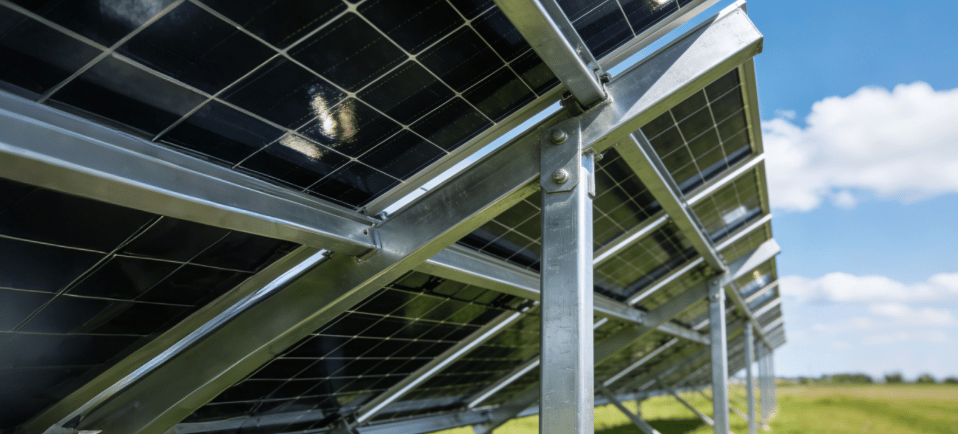
Pile-Driven Ground Mounts: Steel piles driven into soil, suitable for most soil types. Advantages: Fast installation, low soil disturbance, high load capacity.
Concrete Foundation Mounts: Concrete footings for soft soil/marshy areas or high seismic regions. Advantage: Ultra-strong stability for extreme environments.
Screw Pile Mounts: Cost-effective alternative; helical screws twisted into ground. Advantages: Low cost, short construction period, reusable.
Carport Mounting Systems: Dual-Purpose Space-Saver
Integrates solar generation with parking — panels mounted above parking spaces provide shade and clean energy. Applications: Commercial properties, malls, office parks. Advantages: Maximizes space use, boosts parking lot value, slight efficiency gain via shading.
Floating Mounting Systems: Land-Scarce Region Innovation
Installed on reservoirs, lakes, lagoons — ideal for dense cities/small islands. Made of corrosion-resistant materials (aluminum alloy, 304/316 stainless steel). Advantages: Water cools panels, boosting efficiency by 5–10%; reduces water evaporation.
Specialized Mounts: Niche Applications
Wall Mounts: Attached to vertical walls (preferably south-facing), suitable for small residential use with limited space.
Awning/Canopy Mounts: Integrated into outdoor awnings, combining sunshade, rain protection and power generation.
Agricultural Solar Mounts: Mounted above farmland for "agriculture-power dual use," suitable for sunny agricultural regions.
2. Classification by Adjustability: Key to Energy Yield
Panel adjustability determines sunlight capture and energy efficiency, helping balance cost and performance based on energy needs.
Fixed Mounting Systems: Common & Cost-Effective
Fixed tilt angle (matching local latitude) for stable annual yield. No moving parts, low maintenance. Suitable for residential/small commercial projects prioritizing cost control. Note: Yield not maximized seasonally.
Adjustable Mounting Systems: Cost-Efficiency Balance
Manual seasonal angle adjustment (steeper in winter, shallower in summer) boosts yield by 10–15% with slight cost increase. Popular for rural homes/small farms with significant seasonal sunlight differences.
Solar Tracking Systems: Max Efficiency for Large-Scale Projects
Panels auto-follow sun trajectory for maximum exposure, ideal for utility-scale farms pursuing high yield:
Single-Axis Trackers: Rotate along one axis, boosting yield by 20–30% vs fixed mounts. Advantages: Lower cost/maintenance, widely used in large farms.
Dual-Axis Trackers: Rotate along two axes for year-round tracking, 30–40% yield increase. Disadvantages: Higher cost/maintenance. Suitable for high-latitude regions/research facilities.
3. Classification by Fixation Method: Safety & Applicability
Fixation method affects system stability and structural damage, with three common types:
Ballasted Mounts: Weight-fixed (no drilling), suitable for flat roofs/sensitive ground. Advantages: Non-destructive; Disadvantages: Requires sufficient load capacity.
Penetrating Mounts: Drilled into load-bearing structures, suitable for sloped roofs/ground installations. Advantages: Strong wind/snow resistance; Note: Need waterproof/anti-corrosion treatment.
Adhesive Mounts: Industrial adhesives for lightweight panels on smooth roofs. Advantages: Non-destructive, quick installation; Disadvantages: Limited load capacity, not for heavy panels/extreme weather.
Q&A: Key Selection Questions
Answers to common customer questions for informed decisions:
Q1: I have a leased commercial flat roof — which mounting system should I choose?
A: Ballasted roof mounts are optimal — no drilling avoids roof damage/leakage (critical for leases). Choose lightweight composite weights if roof load is limited.
Q2: For a utility-scale solar farm in a sandy desert area, which ground mounting system is most suitable?
A: Pile-driven or screw pile mounts are ideal. Deep piles ensure stability in sandy soil; screw piles save cost by avoiding heavy drilling equipment.
Q3: Is a solar tracking system worth investing in for a residential solar project?
A: Generally not. Tracking systems cost 20–30% more, extending payback for small residential installs. Seasonally adjustable mounts are more cost-effective.
Q4: Can floating mounting systems be used in saltwater environments (e.g., coastal lagoons)?
A: Yes. Use 316 stainless steel brackets and HDPE floats for saltwater resistance. Conduct annual anti-corrosion inspections for longevity.
Conclusion: Choose Based on Comprehensive Needs
Classification by location, adjustability and fixation provides a clear selection framework. Consider site conditions, energy needs, budget and maintenance costs. For example, urban residents prefer cost-effective roof-fixed systems; utility-scale farms opt for ground-mounted single-axis trackers. Matching the right system maximizes project stability and profitability.
Unit 10, Smithfield Road Industrial Hengshui
Hebei Province
Beijing
China
+86 18633908188
tony.buy@gmail.com